Strengthen Your Internet Privacy
Temporary Emails and Disposable Phone Numbers Make it Happen Quickly.


Photo by Zen Chung on Pexels. link
Email Privacy
I’ve already covered email privacy in the articles cited below.
You should be able to send and receive emails without being bothered by spammers or other intrusive people who misuse your contact information. That is one of the many reasons why people are distancing themselves from Facebook, other Meta products, and Google. Because of the intrusiveness of predatory capitalism, our personal information has become the product of these technologies. Meta and Google profit from selling our email addresses, phone numbers, and other personal information.
Here are links to my articles using Medium’s “Friend Links.” These links give you access without a paid Medium.com membership. These are my previous articles about maintaining your privacy online.¹

¹ Articles on Email Privacy

“Protecting Your Privacy with Multiple ProtonMail Email Accounts:”
(Why You’ve Jettisoned Gmail and Other Free Email Services for the Sake of Maintaining Your Privacy) link
“Fifteen Reasons You Might Want a Virtual PO Box” link
“Creating Disposable Emails for Free, Anytime and Anywhere:”
(Now you can finally control who gets to send you an email.) link
“Should You Encrypt Your Emails?”
(If you read the news, the hate groups may drive you to encryption.) link
“Psychographics, Facebook and the End of Your Privacy” link
“Receiving Useless Catalogues?”
(You’re no longer a prisoner of your mailbox.) link

These articles help you achieve privacy on the internet. They give you real options for protecting your email account. The next frontier is protecting your telephone number.

Phone Privacy

Photo by Diva Plavalaguna on Pexels. link
Keeping your cell phone number out of the hands of spammers and con artists is more difficult than protecting your email. That’s because access to our cell phone numbers is more personal. More direct. If the phone rings, and we cannot see who is calling, we answer it. We answer it because it might be important. It could be an emergency. Perhaps it is a loved one calling from a borrowed phone, needing our help.
Then again, it might be someone from an Asian country with good English pronunciation claiming there is a problem with our Social Security account.
We are dependent on being accessible to our friends, relatives, and business associates. With email, we can more easily keep scammers away. But when we are speaking with an unseen person on the phone, our only defenses are our own judgment, personal experience, and a healthy smidgen of skepticism.
By now, we know scammers try to scare us by lying about threatening conditions that might cost us money or endanger our lives. We could be running into this greed-based, predatory behavior most anywhere, but we usually encounter it on our telephones.
Like using disposable email accounts, which totally hide our primary email, we can do the same with a disposable phone number. By giving an alternative phone number (which rings our cell phone), the caller never knows our real number. If the caller proves to be a scammer or otherwise disreputable, we can eliminate that second number and switch to a new one.
When an unscrupulous caller calls, and we block the spammer by eliminating our temporary phone number, we no longer exist. The number the spammer used is now useless. This method is called “a temporary, disposable number.”
We might argue that current phone technology enables us to block unwanted callers. That is true, but phone scammer call centers have the technology to quickly switch to calling you back from different phone numbers. Every time they are blocked from calling your phone number, they can effortlessly call you again from another line. But if your phone number disappears, they will not be able to find you. To the scammer, you don’t exist.

The Dilemma of Disposable Phone Numbers
There are times when we don’t want just anyone to reach us. For our privacy, we don’t want to give our regular primary cell number to spammers, aggressive salespeople, or people we already know are undesirable.
The problem is that we use our phones constantly. If we call anyone, they can see our number immediately. So, unless we have an unlisted or disposable phone number, it is nearly impossible to keep our phone number private. But we do want most people to be able to reach us.
There are circumstances when we must put a phone number out in the wild for strangers to call us back. Recently, a neighbor found car keys in the street. She wanted the owner to know their keys had been found.
That’s the perfect case for a disposable phone number. That temporary phone number can appear on a neighborhood poster advertising where the car key was found. Once the owner responds and retrieves their lost keys, the phone number can be easily replaced with a new one. Strangers will never know your real phone number, even though they spoke or texted with you using the temporary number.
A Matter of Trust
Here is the most challenging problem with getting a second phone line. It relates to trust. In most cases, we trust others. We don’t think that when we share our phone number, most people are lying spammers who want our money and privacy for their own gain. We also don’t think people we meet will share our phone number with spammer organizations. While we may have to block an occasional spammer, we can do that on our phones or on any of these 2nd cell phone apps.
We trust people and hope for the best in others. But if you look at the number of articles I have written on the subject, you might be wondering about my own paranoia. There are plenty of internet security articles. The fact that you are this far down in this article might give you some assurance from your own experience.
The challenging question for all of us is the tension between wanting our friends and relatives to reach us by phone reliably, and the rare case we must remove one of our phone numbers from a person’s access.
If we replace a number, it will prevent a spammer (or unwanted person) from calling us, but it will also ghost anyone else using that number!
How do we know which person or organization gets the temporary number? That’s the hardest decision in these circumstances.
· Dating sites on the internet.
· A stranger who requests to contact us for some temporary repair or an emergency need.
· A storefront or internet merchant who wants to set up an account and profile for you to get a product or service.
· A well-meaning political gathering of operatives who are trying to build a coalition for justice, truth, and the American way.
· A note to an unknown person whom you’re trying to help out, who may need to call you for a follow-up in a few days.
· An untrusted merchant who may sell your phone and email to gain revenue from the sale of your information. (This is why I no longer go on Facebook.) (link)
And even if you have guessed wrong and someone turns out to be undesirable, you can always change your second phone number. You only want to use your temporary second phone number for strangers and unproven companies. Otherwise, you can block unwanted callers on your regular cellular number.
How much use can one get out of a second phone number that differs from their regular cell number? What do I use for a secondary cell phone number?

My Summary and Suggestions
In addition to my primary cell number, I have three secondary lines.

My first alternative number was a Burner phone. This enabled me to have a separate cell number for our modest candle business. It worked fine, but it was expensive. (About $55 / year for a verified number, about $100 / year for a premium one.) link
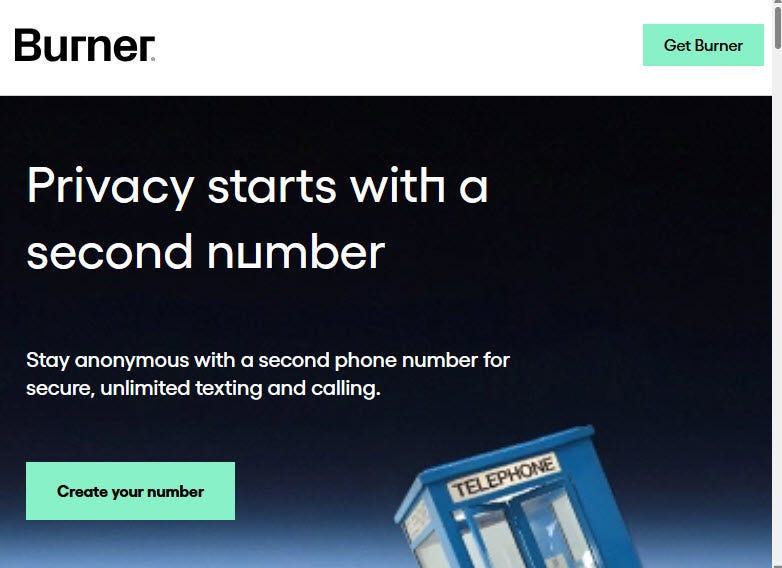
Screenshot of the Burner website by the author.
The second secondary cell number I have is my free Google Voice number.
Google Voice
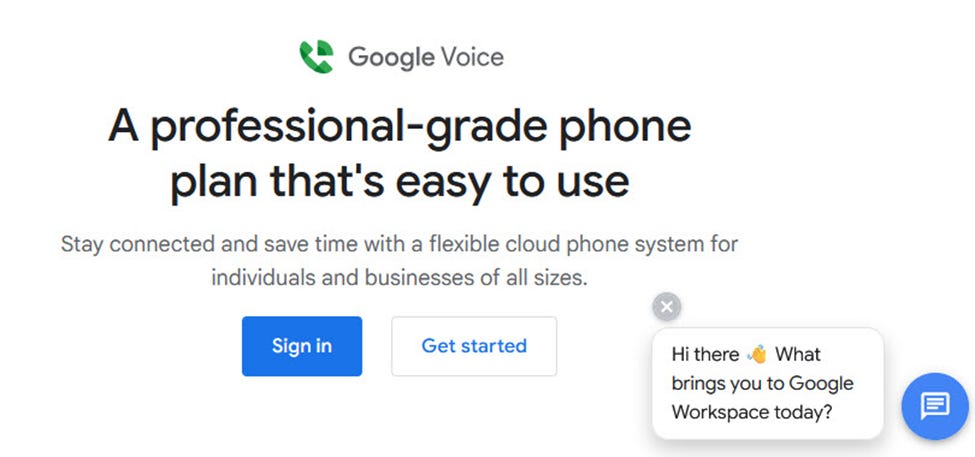
Screenshot of the Google Voice website by the author.
To save money, I switched to using a free Google Voice number for business voice and text. If the number was being misused, I could always change it and update it on the Voice website. If I changed the number, however, I would have to change it on our business website. Thankfully, that has never happened. link
TextNow
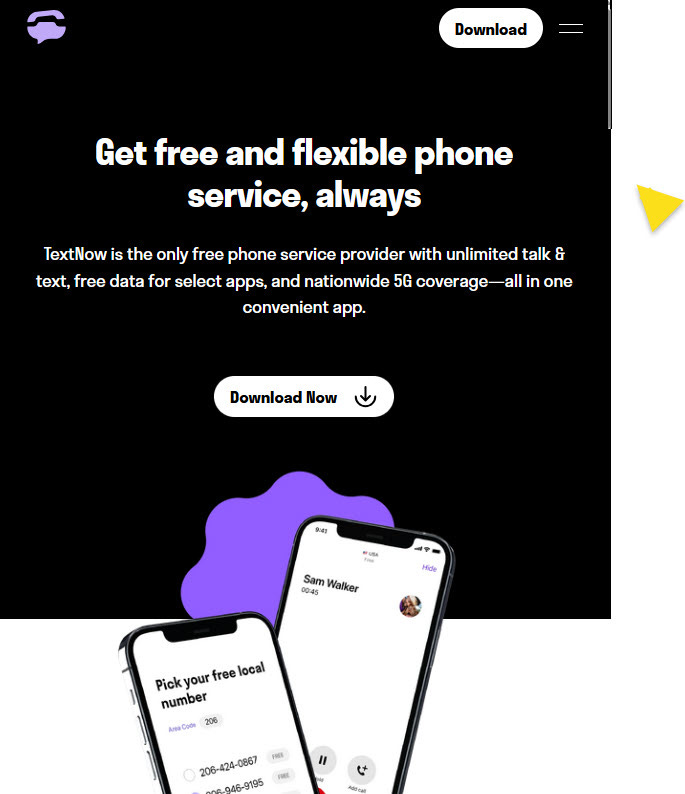
Screenshot of the TextNow website by author.
For infrequent or temporary situations, I use a free TextNow number. (link) With it, strangers and I can use the number to call or text one another. It is free. I paid a one-time fee of only $4.00 to have an eSIM number assigned to that phone number. It enables me to call or text from anywhere outside our home Wi-Fi.
While I can call or text anyone freely, I do see little ads appear on my cell phone screen. To eliminate an ad, all I have to do is tap the “X” in the top corner of the screen, and it disappears. TextNow makes money by selling ad space to other vendors and providing users with a disposable phone number for free.
I could pay TextNow extra money to (1) keep the number I have chosen or (2) get rid of the ads that appear. I have chosen not to do either. To retain a free number, I use that TextNow number every day. If I forget to use that number daily, they may take the number away (so another person can use it). If that happened, I would start texting from the new number to keep it the number for as long as I need it. (A car mechanic may need to contact me in a couple of days. I need to keep that temporary number until I hear back from the garage.) link
In conclusion
If you want a separate phone number for your business or hobby, subscribe to a dedicated Burner number or use your Google Voice number for free. With Google Voice, however, you’ll have to use the number at least once a month to retain it.
But if you want another phone number for very infrequent situations where there may be trust issues, I’d recommend a TextNow number.

For conducting your own research, here are the articles summarizing the 2nd phone number options. To save you time, see the resource links to their websites for a more in-depth summary of the app’s capabilities.²

² Resource Articles
Try free trials when available to find the app that fits your style before subscribing.
Second Phone Number Apps (article) link
Disposable phone number (article) link
Compare the best disposable number apps for privacy and pricing (article) link.
Another review of phone apps (most of which are mentioned in the above articles) link
Apps Reviewed in All The Above Articles
Apps Reviewed in All The Above Articles
Ghost
$4.99/month link

Hushed
From $3.99 pay-as-you-go, subscriptions start at about $5 per month link
QUO (formerly OpenPhone)
out 15 dollars per user per month link
TextNow (Free with ads)
Free with adds, or $9/month without ads. $3.99 one-time charge to call and text away from your home WiFi. With the one-time payment of $4.00 for the addition of the eSIM, you can send and receive calls and texts from anywhere. link
TextFree (Free with ads)
Free with ads. This is almost a carbon copy of the TextNow free plan above. However, when using it, their ads were aggressive and manipulative on numerous occasions. They kept telling me that Apple had determined that my phone was infected with spyware. (It wasn’t) But the advertisers insisted that I click an install link to install their antivirus program. Companies like that are the very reason I want a disposable phone and email accounts. (Avoid TextFree) link
Phoner 2nd
International Reach $5/month, with pay-for -use pricing available $5/month.
Pricing is pay-as-you-go; in-country plans vary by country and usage. link
2nd Line
About $10 a month link
Sideline
$14.99 a month link
CoverMe
A privacy-focused, with end-to-end encryption, disappearing messages, and remote wipe. The review (confusingly) said “it is free but pricy,” so check out the website. About $8 /month. link
CallHippo
From $14.99 per user per month. link
Numero eSIM: Virtual SIM with Global Coverage
FA virtual SIM with Global Coverage for Android pay-as-you-go is available. link
Google Voice
(free US and Canada) free for personal use, business plans with Google Workspace. link
Line2:
About $9.99 per month. link
Grasshopper
A virtual Phone System for Teams $29/month. link
Talkroute
For MAC only. Free (with ads) and optional paid subscriptions. Premium Options. It starts at around $18 a month. link
Taxt Me
Free with ads and optional paid subscriptions, Premium Options. link
Sideline link
Call.com (was Cloud SIM)
A web-only tool. link
Dingtone link
MightyCall link
Flyp link